The short answer
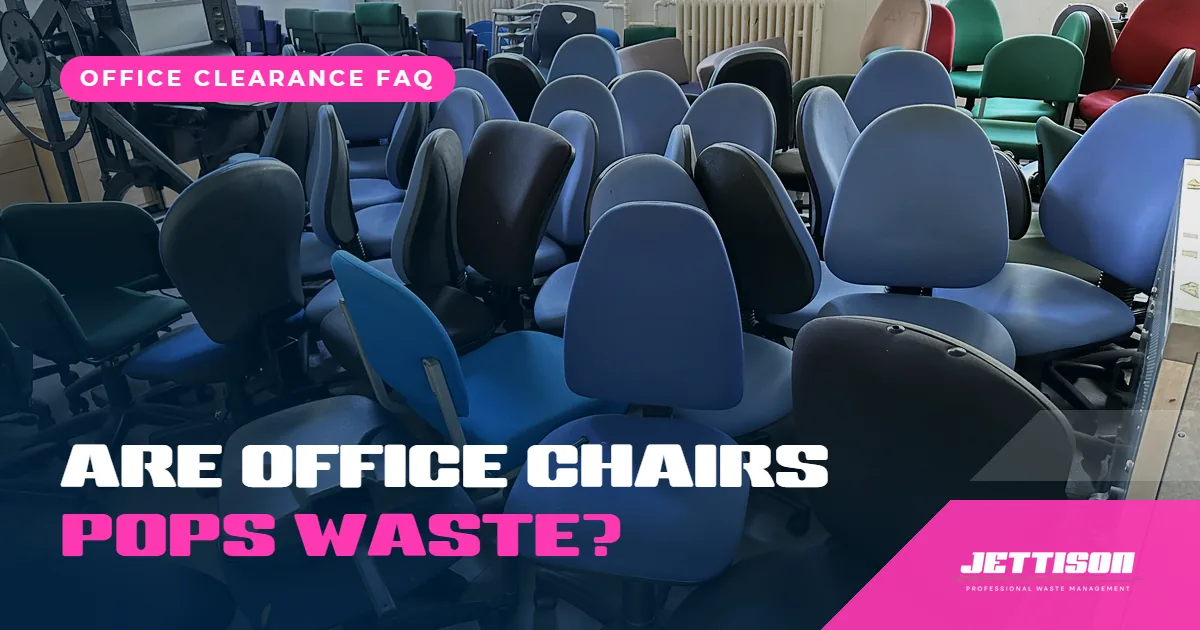
Often, yes. Upholstered office chairs with foam or fabric can contain persistent organic pollutants (POPs) from old flame retardants. In Scotland, NetRegs lists home office chairs alongside sofas and armchairs as seating likely to contain POPs, and commercial seating is considered a particular risk. Seating containing POPs must be kept separate from other waste, cannot go to landfill and has to be destroyed by incineration.
If you are clearing an office, the chairs are usually the biggest single item by volume. Twenty desks might come with forty task chairs, a boardroom set, reception sofas and a pile of spare seats in a store cupboard. Since the rules on waste upholstered seating changed, those chairs can no longer be thrown into a skip with the rest of the office. This guide explains what POPs are, which office chairs are affected, and how to get rid of them properly in Scotland.
What are POPs?
Persistent organic pollutants are chemicals that do not break down naturally in the environment. They build up in living things over time and are harmful to people and wildlife. In furniture, they come from brominated flame retardants that were added to foam and the backs of fabric covers so that seating would meet fire safety standards.
The most common one is decabromodiphenyl ether, known as DecaBDE. NetRegs, the environmental guidance service for businesses in Scotland, explains that upholstered seating made before 2019 is likely to contain these chemicals, and that DecaBDE has been banned since 2019. Other POPs found in seating include HBCDD, PentaBDE and TetraBDE, and the chemicals can also contaminate linings and wadding that touch the foam.
Which office chairs count as POPs waste?
The rules apply to waste upholstered domestic seating, often shortened to WUDS. That sounds like it only covers household sofas, but the definition is wider than most businesses expect:
- The NetRegs guidance for Scotland lists home office chairs among the items that will contain POPs, along with sofas, armchairs, kitchen and dining chairs, stools and cushions.
- The Environment Agency guidance (which applies in England) includes office chairs that are fire resistant to domestic standards, and states that commercial seating is at particular risk of containing POPs and should be considered as part of your duty of care.
- Any part made of or containing leather, synthetic leather, fabric or foam is covered.
Items that are unlikely to contain POPs include chairs with no upholstery at all, such as a solid wooden or plastic chair without a cushioned seat, back or arms.
In practice, most typical office seating has a padded seat and back, so the safe approach is the one NetRegs sets out: if you are unsure whether seating contains POPs, assume that it does and manage it accordingly.
Can you put office chairs in a skip?
Not mixed in with everything else. This is where many office moves go wrong. Under the POPs rules you must take all reasonable steps to avoid contaminating other waste with POPs waste. If upholstered chairs go into a general skip with desks, carpet and cardboard, the guidance is clear that the whole load can then be treated as POPs waste. That means the entire skip may have to be sent for destruction rather than recycling, which is expensive and wasteful.
Chairs can travel on the same vehicle as other waste, but only if they are not damaged, not mixed and kept segregated during transport and unloading. A skip company may refuse a skip with chairs in it, or charge extra to deal with it.
What has to happen to POPs office chairs?
Seating that contains POPs must be disposed of in a way that destroys the chemicals. In Scotland that means:
- Segregation. Chairs are kept apart from other waste so nothing else is contaminated.
- Careful handling. They are stored and moved in a way that does not tear foam or covers and release particles.
- Correct paperwork. The waste transfer note uses the code 20 03 07 and lists the chemicals present or likely to be present.
- Incineration. The seating goes to a high temperature incinerator or energy from waste plant. Landfill sites must not accept it.
The NetRegs page links to the SEPA guidance on waste upholstered domestic seating for full detail.
Can office chairs be reused instead?
Reuse is always better than disposal, and good quality chairs from a clearance can often go on to another business, a charity or a social enterprise. The POPs rules are aimed at seating that has become waste. Whether a particular item can be reused depends on its condition and on the guidance for reusing seating that may contain POPs, so it is worth asking your clearance company how they decide. You can read more about what happens to reusable items in our guide to where office furniture goes after an office clearance.
What about other office furniture?
Desks, pedestals, metal filing cabinets, shelving and partition frames are not upholstered seating, so the POPs rules do not apply to them in the same way. They can usually be reused or recycled for their metal, wood and plastic. Some office items are a different matter altogether: fluorescent tubes, toner and some electrical equipment can be special waste in Scotland. We cover those in is office furniture classed as hazardous waste? and the metal side in how to dispose of old metal filing cabinets.
Who is responsible if chairs are disposed of wrongly?
Every business has a duty of care for the waste it produces. That responsibility does not end when the van drives away. If you hand chairs to an unregistered carrier, or describe them wrongly on the paperwork, you can be held responsible if they end up fly-tipped or sent to landfill. Always check that whoever takes your chairs is a registered waste carrier and that you receive a correctly completed waste transfer note. Our guide to waste transfer notes for office clearances in Scotland explains what that note should include.
How Jettison handles office chairs
On every office clearance we separate upholstered seating from the rest of the waste on site, so the chairs never contaminate desks, metal or cardboard that can be recycled. Jettison removes and disposes of all office furnishings in accordance with Persistent Organic Pollutants legislation, and you receive a waste transfer note when the work is finished, with a full waste audit trail available if you need one.
If you are planning a move or refurbishment in Glasgow or anywhere else in central Scotland, our office clearance team in Glasgow can include chairs, sofas and soft seating in your quote. For a broader planning checklist, see our commercial office furniture clearance guide.
Frequently asked questions
Do all office chairs contain POPs?
Not all, but most upholstered office chairs made before 2019 are likely to. Chairs with no foam or fabric, such as solid plastic or wooden chairs, are unlikely to contain POPs. If you cannot be sure, NetRegs advises treating the seating as if it does contain POPs.
Can I put office chairs in a general waste skip?
No. Upholstered chairs that may contain POPs must not be mixed with other waste. If they are, the whole skip can be treated as POPs waste and sent for destruction, which costs more and stops the rest of the load being recycled.
Can office chairs go to landfill?
No. Landfill sites must not accept waste upholstered seating that contains POPs. It has to go to a high temperature incinerator or an energy from waste plant where the chemicals are destroyed.
What waste code is used for POPs seating?
Waste upholstered domestic seating containing POPs is described on the waste transfer note under code 20 03 07, and the note should list the chemicals present or likely to be present.
Do the POPs rules apply to sofas in office reception areas?
Yes. Reception sofas, armchairs, upholstered stools and cushions are all upholstered seating and should be handled in the same way as office chairs.