The short answer
Empty them first and destroy any confidential paperwork securely. Then, in order of preference, reuse or sell cabinets that are in good condition, donate them, or send them for metal recycling. Steel filing cabinets are almost entirely recyclable. From a business they are commercial waste, so they need to go with a registered waste carrier and a waste transfer note, not to a household recycling centre.
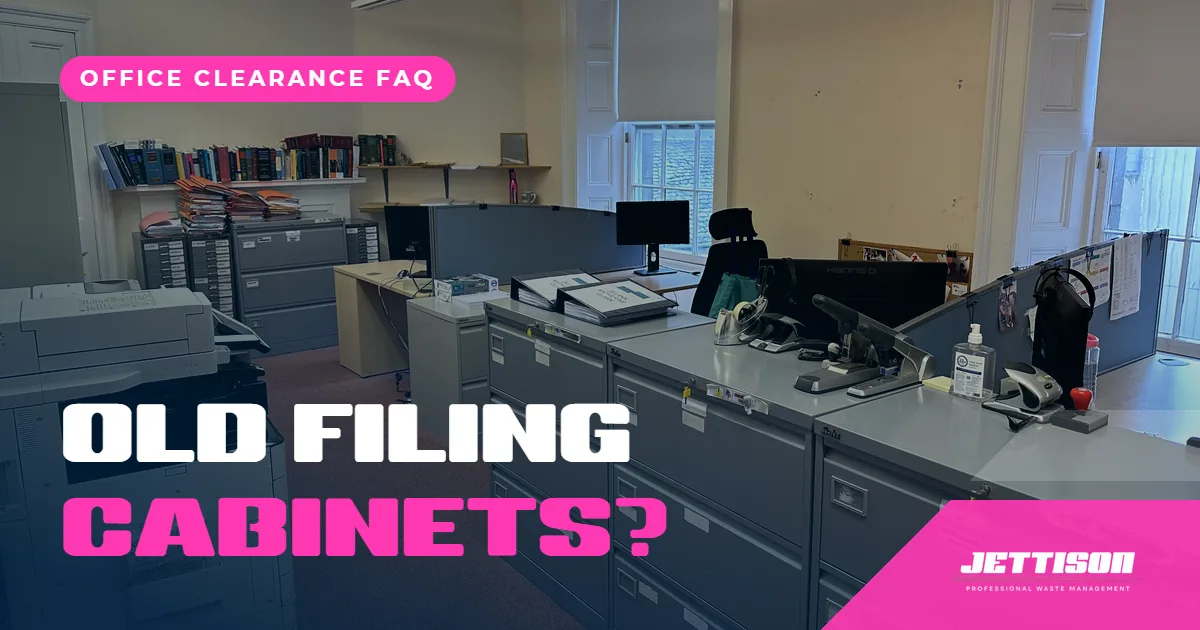
Filing cabinets are one of the most awkward items in any office clearance. They are heavy, they are often full, keys go missing, and four-drawer units are a serious lifting risk on stairs. As more businesses go paperless, cabinets that have sat in the same corner for twenty years suddenly need to go. This guide covers how to get rid of them properly.
Step 1: Empty them and deal with the paperwork
The contents matter more than the cabinet. Old files often hold personal data about staff, clients and suppliers, which is why you should never send full or partly full cabinets for scrap. Before anything else:
- Check every drawer, including the back of each drawer and the space underneath, where loose papers often fall.
- Decide what you must keep for legal or accounting reasons and what can be destroyed.
- Send the rest for secure shredding with a certificate of destruction, so you have a record that the data was destroyed properly.
Our guide to secure shredding and document destruction explains how that process works. On a Jettison clearance, confidential documents are shredded on site or off site depending on volume, and all paper is recycled after destruction.
Step 2: Find the keys or plan to open locked cabinets
Locked cabinets with no key are very common. Locksmiths can open most office cabinets, and a clearance team will usually be able to open them carefully on site. Do not let anyone drill or force a cabinet open in a way that damages the contents if you have not yet confirmed what is inside.
Step 3: Decide whether it can be reused
A sound, rust-free cabinet with working runners and a key still has a use. You can:
- Move it to another office or use it for storage in a workshop, garage or warehouse.
- Sell it. Fire resistant cabinets and good quality lateral filing units can have resale value.
- Donate it to a charity, school, community group or social enterprise that needs storage.
Reuse keeps an item in service and avoids the energy needed to melt and reform the steel. It is also the top of the waste hierarchy that Scottish businesses are expected to follow.
Step 4: Recycle the metal
Most filing cabinets are made almost entirely of steel, which is one of the easiest materials to recycle. Damaged, rusty or broken cabinets should go for metal recycling rather than landfill. A few things to know:
- Plastic handles, label holders and runners are usually separated at the metal recycling site.
- Some fire resistant cabinets and older safes contain an insulating layer inside the walls. If a cabinet is cracked or damaged, tell your clearance company so the material can be checked before it is broken up.
- Wooden filing cabinets can often be reused or recycled as wood waste.
Can you take filing cabinets to the tip?
Not if they come from a business. Glasgow City Council, for example, does not accept commercial waste at its Household Waste Recycling Centres, and other Scottish councils have similar rules. Business waste needs to go through a licensed route with a waste transfer note. We explain the Glasgow position in more detail in can you take office furniture to the tip in Glasgow?
Moving filing cabinets safely
A loaded four-drawer cabinet can weigh as much as an adult, and even an empty one is top heavy and awkward. To move them safely:
- Empty every drawer completely before moving.
- Lock or tape the drawers shut so they cannot slide open and tip the cabinet.
- Use a sack truck or stair climber with straps rather than carrying cabinets by hand.
- Never move cabinets down stairs alone.
- Protect floors, lift doors and door frames, especially if you need to leave the premises in good condition for the landlord.
What about the rest of the office?
Filing cabinets rarely go on their own. Desks, pedestals, shelving and partitions can usually follow the same reuse and recycling routes. Upholstered chairs are different, because they may contain POPs and must be kept apart from other waste. Read are office chairs POPs waste? before you put any chairs in the same load. For a full list of what is typically removed, see what will be cleared and disposed of in an office clearance.
Lateral, vertical and fire resistant cabinets
Not every cabinet is the same, and the type can change the best route for disposal:
- Vertical four-drawer cabinets are the most common. They are usually all steel and recycle easily, but they are heavy and unstable when moved.
- Lateral filing cabinets and tambour units are wider and often in better condition, so they are more likely to be reused or resold.
- Fire resistant cabinets are much heavier because of the insulated walls. They can have good resale value, but need more people or equipment to move, and any damaged units should be checked before they are broken up.
- Plan chests and card index cabinets from architects, engineers and libraries are often sought after for reuse.
Do not forget the data on top of the cabinet
Filing areas often hide other items that need care, such as old backup drives, CDs, USB sticks and archive boxes stacked on top or alongside. These can hold just as much personal data as the paper files, so include them in your secure destruction plan. Our IT equipment disposal guide explains how data bearing devices should be handled.
Getting filing cabinets cleared with Jettison
We clear filing cabinets every week as part of our office clearances across Scotland. We can empty them, arrange secure shredding of the contents, carry them out safely and send them for reuse or metal recycling. Over 90% of what we collect is reused, recycled or repurposed, and you receive a waste transfer note at the end of the job. You can find out more about what happens next in where office furniture goes after an office clearance.
If you have a few cabinets or a whole floor of them in Glasgow or the surrounding area, our Glasgow office clearance team can help, and you can request a free quote with photos.
Frequently asked questions
Can metal filing cabinets be recycled?
Yes. Most filing cabinets are made almost entirely of steel and can be recycled at a metal recycling facility. Plastic parts such as handles and label holders are separated during processing.
Should I empty filing cabinets before disposal?
Always. Files often contain personal or confidential data. Check every drawer and send anything you do not need to keep for secure shredding with a certificate of destruction.
Are old filing cabinets worth any money?
Good quality cabinets in sound condition, especially fire resistant ones, can have resale value. Damaged or very old cabinets are usually only worth their scrap metal value.
Can I put filing cabinets in a skip?
Empty metal cabinets can go into a skip for metal recycling, but they should not be mixed with upholstered office chairs, which may contain POPs and contaminate the whole load.
How do I open a locked filing cabinet with no key?
A locksmith or your clearance company can usually open office filing cabinets on site. Avoid forcing them in a way that damages the contents before you know what is inside.